


Prayer
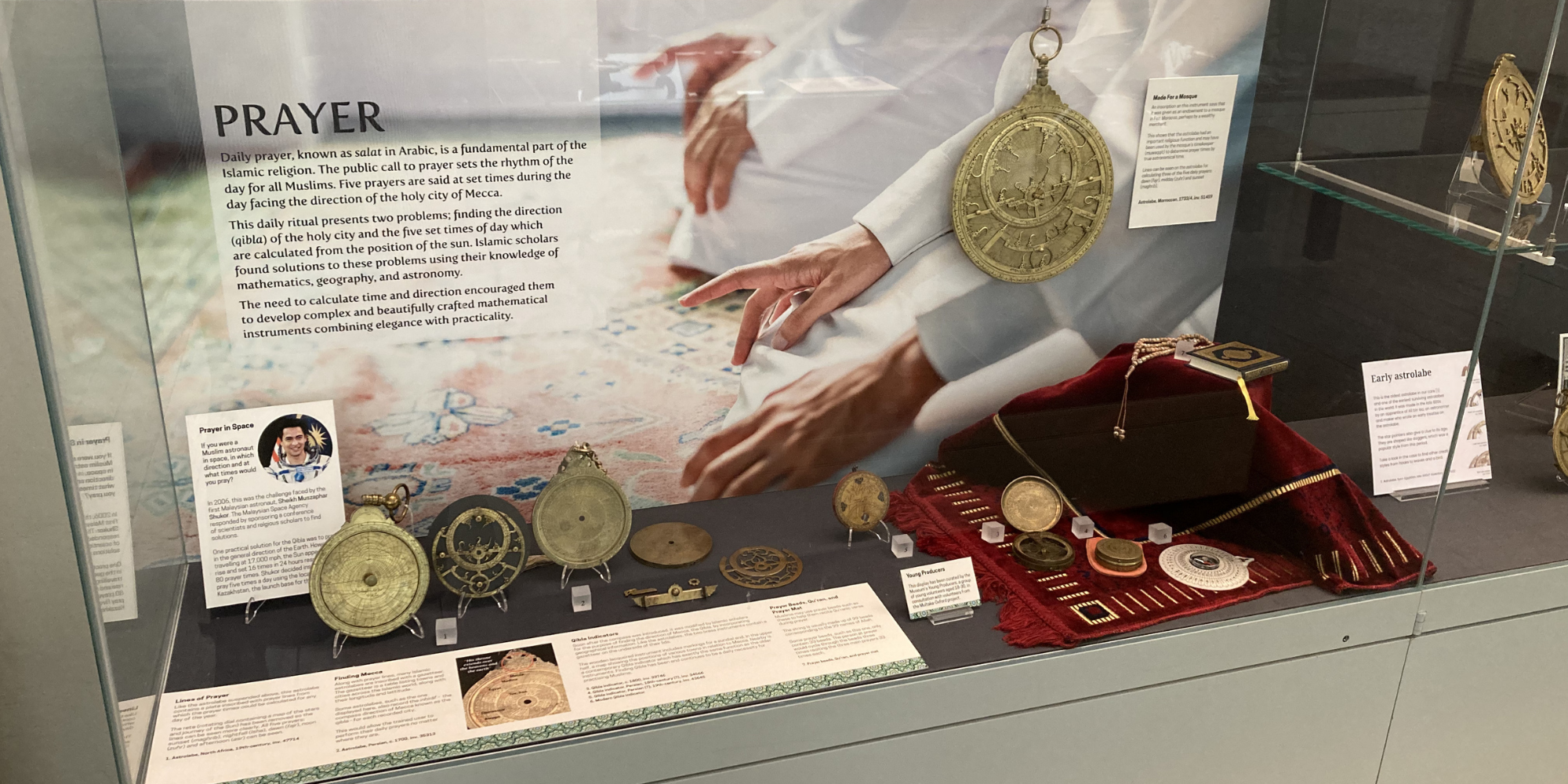
During 2019, a group of Young Producers (volunteers aged 18-30) worked with the MultakaOxford team to create a fresh display in the Top Gallery's Islamic World case.
Taking the theme of Prayer, they drew on visitor feedback to create a display with a more personal feel. The labels tell engaging, informative stories and the prayer mat holds contemporary objects alongside two Qibla indicators (used to find the direction of Mecca for prayer).
The group also discussed how a Muslim might pray in space. As a last-minute addition, they included a story about the first Muslim astronaut.
We felt that this extra, fun bit of information would make a contemporary link with this display, helping visitors to engage with the content.
Read the full story in our blog post: Young Producers Curating Prayer: A display in the Islamic World collection.
From August 2019 -
Top Gallery
This astrolabe contains a plate inscribed with prayer lines from which the prayer times could be calculated for any day of the year.
The rete (rotating dial containing a map of the stars and journey of the Sun) has been removed so the lines can be seen more clearly.
You can see all five prayers:
- sunset (maghrib)
- nightfall (isha)
- dawn (fajr)
- noon (zuhr) and
- afternoon (asr).
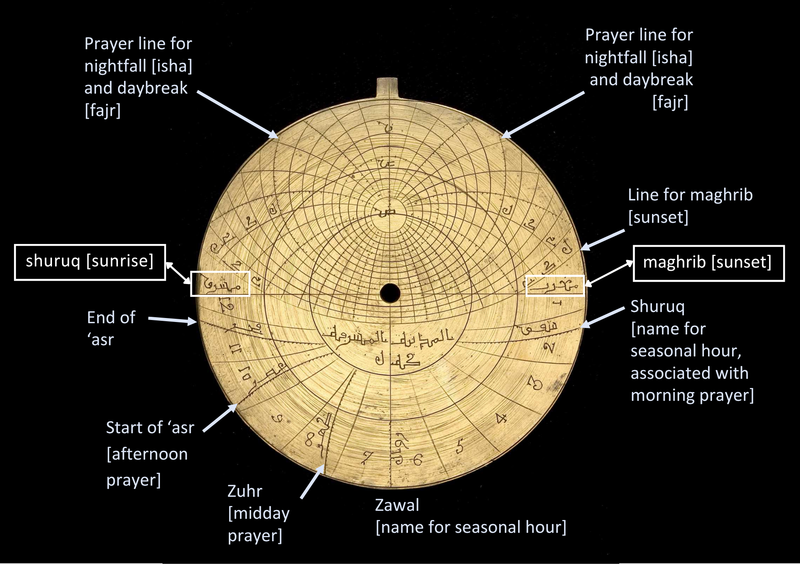
Lines of prayer on Astrolabe, North African, 1800s, Inv. 47714
Along with prayer lines, many Islamic astrolabes are inscribed with a gazettteer.
The gazetteer is a table listing towns and cities across the Islamic world, along with their longitude and latitude (which together identify their exact location on Earth).
Some astrolabes, such as the one displayed here, also record the inhiraf - the compass direction of Mecca known as the qibla - for each recorded city.
This would allow the trained user to perform their daily prayers no matter where they are.
2. Astrolabe, by Khalil Muhammad and `Abd al-A'imma, Persian, c. 1700. Inv: 35313
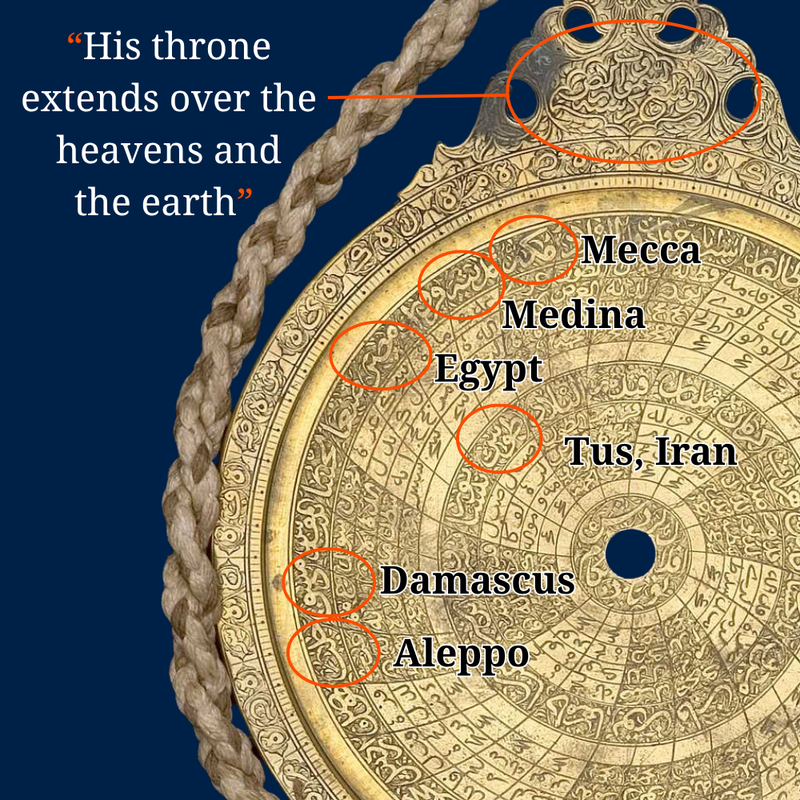
Gazetteer for Astrolabe Inv. 35313 showing locations in the Islamic world
Soon after the compass was introduced, it was modified by Islamic scholars for the purpose of finding the direction of Mecca, the Qibla, by incorporating geographical information.
Like the astrolabes, the two brass instruments contain a gazetteer on the underside of their lids.
The wooden lacquered instrument includes makings for a sundial and, in the upper half, a map showing the positions of various towns in relation to Mecca.
Nearby is a contemporary Qibla indicator which has exactly the same function as the older instrument. Finding Qibla has been and continues to be a daily necessity for practising Muslims.
3. Qibla indicator, c. 1800. Inv. 33746
4. Qibla indicator, Persian, 1700s(?). Inv. 34566
5. Qibla indicator, Persian(?), 1800s. Inv. 43645
6. Modern Qibla indicator
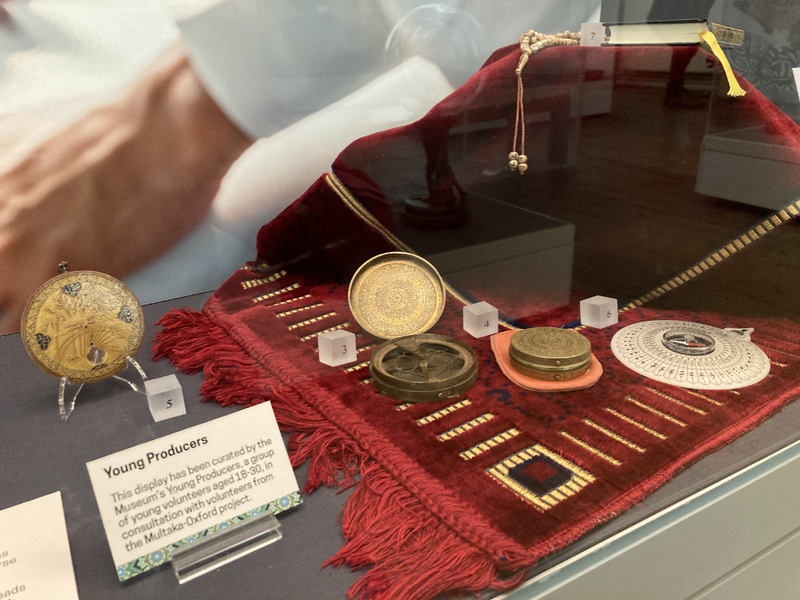
Qibla indicators
Muslims may use prayer beads such as these to help them recite Qu'ranic verse during prayer.
The string is usually made up of 99 beads corresponding to the 99 names of Allah.
Some prayer beads, such as this one, only contain 33 beads. The person at prayer would cycle through the beads three times reciting the three main prayers 33 times each.
7. Prayer beads, Qu'ran, and Prayer mat
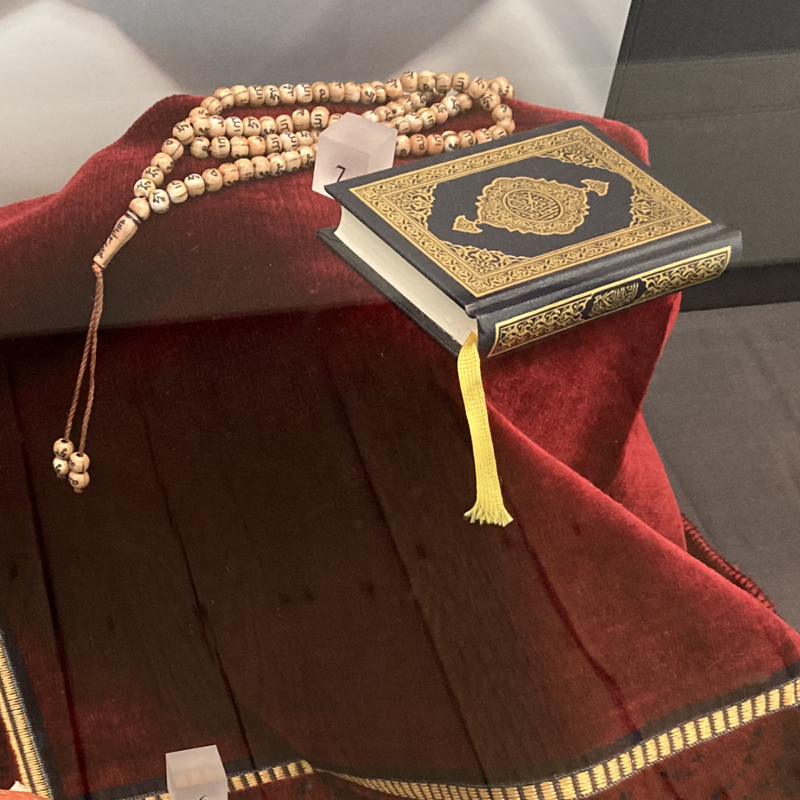
Prayer beads, Qu'ran and prayer mat
An inscription on this instrument says that it was given as an endowment to a mosque in Fez. Morocco, perhaps by a wealthy merchant.
This shows that the astrolabe had an important religious function and may have been used by the mosque's timekeeper (muwaqqit) to determine prayer times by true astronomical time.
Lines can be seen on the astrolabe for calculating three of the five daily prayers:
- dawn (fajr)
- midday (zuhr), and
- sunset (maghrib).
8. Astrolabe, by Muhammad ibn Ahmad al-Battuti, North African, 1733/4. Inv: 51459
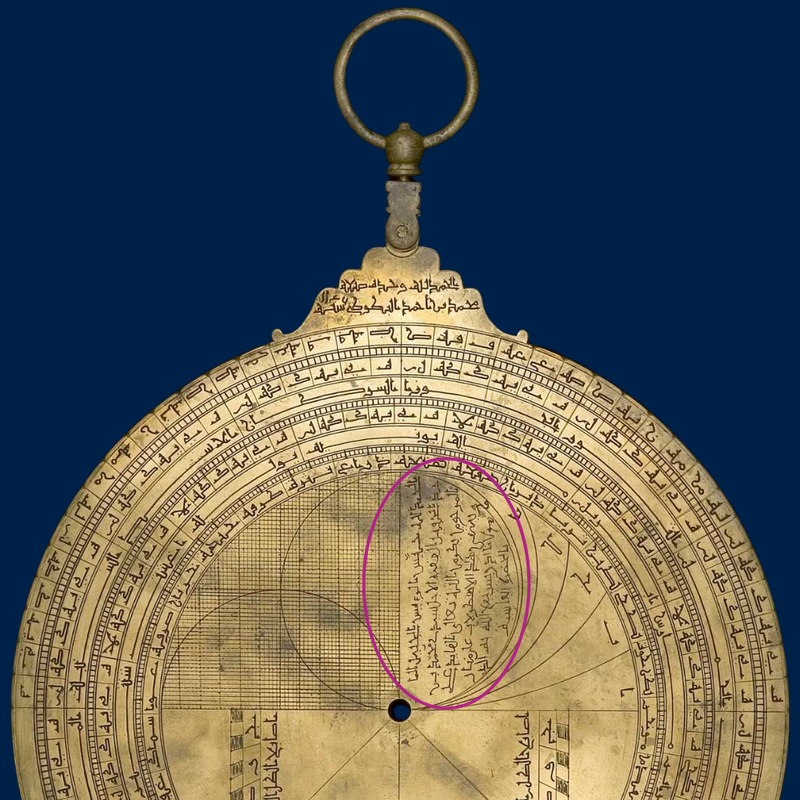
Circled is the inscription showing this astrolabe was made for the mosque in Fez. Inv. 51459
If you were a Muslim astronaut in space, in which direction and at what times would you pray?
In 2006, this was the challenge faced by the first Malaysian astronaut, Sheikh Muszaphar Shukor. The Malaysian Space Agency responded by sponsoring a conference of scientists and religious scholars to find solutions.
One practical solution for the Qibla was to pray in the general direction of the Earth. However, travelling at 17,000 mph, the Sun appears to rise and set 16 times in 24 hours resulting in 80 prayer times.
Shukor decided instead to pray five times a day using the local time in Kazakhstan, the launch base for the shuttle.
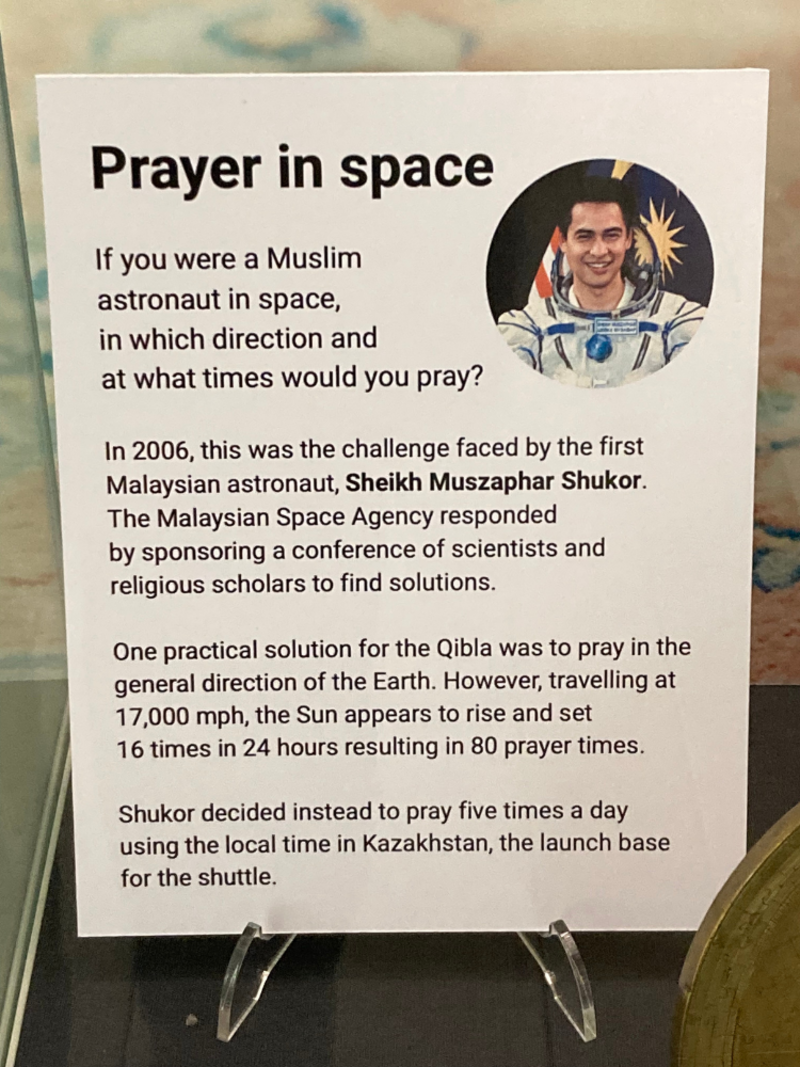
Prayer in space

